
There are 4.3 million TEU ports waiting to be berthed in the world, and the situation of port conges
- Author:Maintenance network
- Source:Maintenance network
- Release Date:2026-08-29
Typhoon "Shadr" has landed in Zhejiang on August 28. The impact on East China's core ports is moving from simple port stops for typhoon prevention to further transmission to ships waiting for berthing, voyage adjustments and effective capacity turnover.Hapag-Lloyd's 35th week Asia and Oceania operations update released on August 26 showed that the average waiting time for some ships at Shanghai Yangshan Port has reached 7 to 11 days; at the same time, Linerlytica data shows that as of August 24, the container ship capacity waiting to berth at global ports has exceeded 4.3 million TEU, and the absolute scale exceeds the peak of approximately 4 million TEU during the 2022 epidemic.
The longest wait for berth in Shanghai is 11 days, and Ningbo Port has completely suspended operations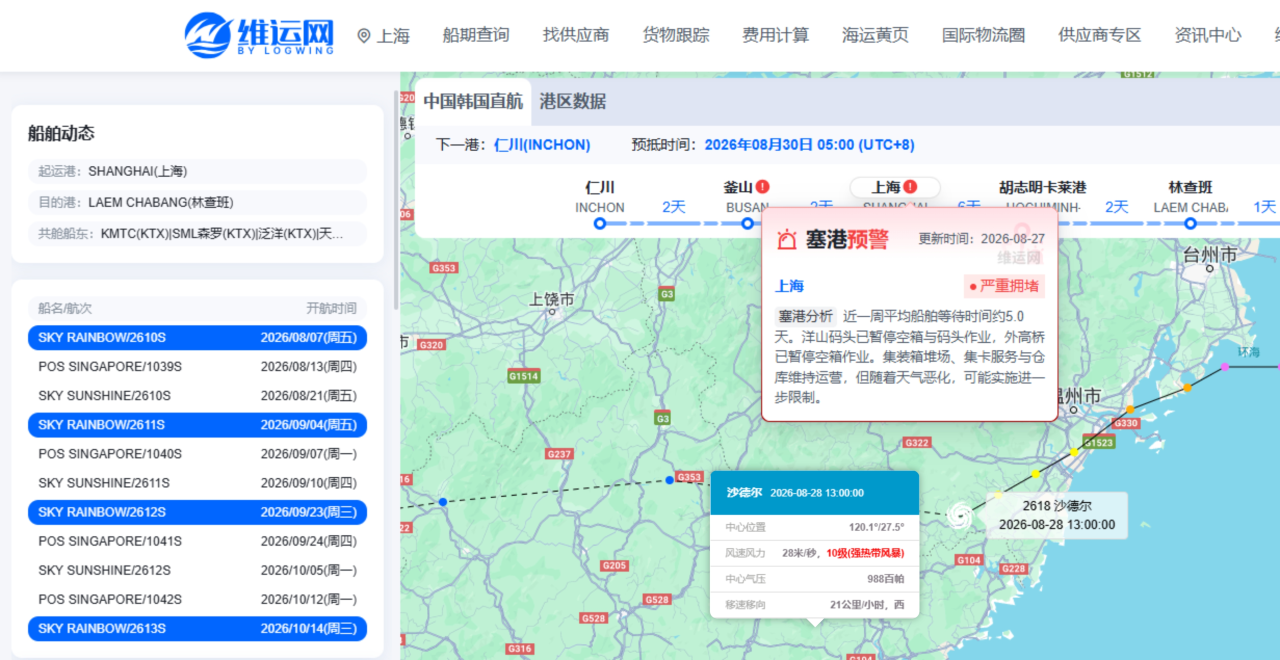
4.3 million TEUs waiting to be berthed globally
The reason why the impact of this typhoon has attracted great attention from the shipping market is not just because of a port closure, but because the East China ports themselves are already at a high level of congestion.Linerlytica data shows that as of August 24, the container ship capacity waiting to berth at global ports has reached approximately 4.3 million TEU, exceeding the absolute peak of approximately 4 million TEU during the 2022 epidemic.There are approximately 2.2 million TEU capacity waiting to be berthed in North Asia, accounting for nearly half of global congestion.Portcast data shows that in mid-August, there were about 139 ships waiting outside the port in Shanghai Port and about 77 ships in Ningbo Port, both at high levels since 2025.However, 4.3 million TEU cannot be simply equated with the data during the epidemic period.At present, the global container ship fleet has expanded to approximately 34.4 million TEU, so 4.3 million TEU accounts for approximately 12.6% of the global fleet; the congestion scale of approximately 4 million TEU in 2022 will account for approximately 15.7% of the global fleet at that time.In other words, the current port congestion has exceeded the epidemic peak in absolute terms, but the relative global fleet size is still lower than the extreme level in 2022.This difference needs to be distinguished when judging market impact.
Industry observation
The longest wait for berth in Shanghai is 11 days, and Ningbo Port has completely suspended operations
According to the Central Meteorological Observatory, the center of Typhoon Shadr made landfall for the first time on the coast of Yuhuan City, Taizhou, Zhejiang Province at 8:00 on August 28. When it landed, the maximum wind force near the center was level 12 (35 meters/second).Subsequently, it made landfall again on the coast of Longwan District, Wenzhou City around 9:10. The maximum wind force near the center when it landed was also level 12 (33 meters/second).Affected by the typhoon, the National Ocean Forecast Station continued to issue red wave warnings and orange storm surge warnings on the morning of August 28.There will be huge to wild waves of 4 to 7 meters in the coastal waters of Zhejiang, and large to huge waves of 3 to 4 meters in the coastal waters of Shanghai.The storm surge warning level in Taizhou and Wenzhou in Zhejiang is orange, and that in Shanghai and Ningbo is blue.
Shanghai Yangshan Port
The "Week 35 – Asia & Oceania Operational Update" released by Hapag-Lloyd on August 26, 2026 pointed out that due to the impact of Typhoon "Shadel" and previous typhoons, the ports of Shanghai and Ningbo are expected to be closed and operating restrictions between August 26 and 29, and the waiting time of East China ports will further increase.Among them, the waiting time for berthing on different routes in Shanghai Yangshan Port has been significantly lengthened: Gemini Alliance ships with a captain's length over 366 meters: an average wait of 5-7 days; Gemini Alliance ships with a ship length below 366 meters: an average wait of 8-10 days; non-Gemini Alliance ships: an average wait of 7-11 days.
Ningbo Port
As for Ningbo Port, the average waiting time for Gemini services is about 4-5 days, and for non-Gemini services, it is about 3-6 days.According to a report by China Communications News on August 27, Ningbo Zhoushan Port organized the evacuation of container ships in batches before the arrival of the typhoon.As of 18:00 on August 26, a total of 55 large container ships have been evacuated from the Ningbo area, and all terminals have been suspended. The Ningbo Maritime Safety Administration launched a Level I typhoon emergency response at 18:00 on August 26.However, it is worth noting that according to the latest information as of 15:00 on the 28th, container loading and unloading operations in Zhoushan Port have resumed from 15:00 on August 28.The recovery of Zhoushan Port marks the gradual transition from the typhoon impact to the resumption of work and production.However, this recovery is a phased recovery when the impact of the typhoon has not completely subsided. In the future, we still need to pay attention to the possible temporary adjustments to the operation arrangements - the early return of sheltered ships to the port, the rescheduling of terminal berths, and the concentrated entry and exit of backlog containers. In the short term, there may be a concentration of ships arriving at the port and a peak in terminal operations.
4.3 million TEUs waiting to be berthed globally
The reason why the impact of this typhoon has attracted great attention from the shipping market is not just because of a port closure, but because the East China ports themselves are already at a high level of congestion.Linerlytica data shows that as of August 24, the container ship capacity waiting to berth at global ports has reached approximately 4.3 million TEU, exceeding the absolute peak of approximately 4 million TEU during the 2022 epidemic.There are approximately 2.2 million TEU capacity waiting to be berthed in North Asia, accounting for nearly half of global congestion.Portcast data shows that in mid-August, there were about 139 ships waiting outside the port in Shanghai Port and about 77 ships in Ningbo Port, both at high levels since 2025.However, 4.3 million TEU cannot be simply equated with the data during the epidemic period.At present, the global container ship fleet has expanded to approximately 34.4 million TEU, so 4.3 million TEU accounts for approximately 12.6% of the global fleet; the congestion scale of approximately 4 million TEU in 2022 will account for approximately 15.7% of the global fleet at that time.In other words, the current port congestion has exceeded the epidemic peak in absolute terms, but the relative global fleet size is still lower than the extreme level in 2022.This difference needs to be distinguished when judging market impact.
Industry observation
What cargo owners need to pay attention to is not the one-day port closure, but the subsequent shipping schedule transmission.For goods recently shipped through Shanghai and Ningbo, the current impact is mainly concentrated in three aspects: first, shipping schedule delays.Some ships in Yangshan are currently facing 7-11 days of waiting for berthing, and the intensive port dredging after the typhoon may still further delay subsequent sailings.Second, jump to the port and dump the goods.In order to restore online schedules, shipping companies have begun to reduce sailing schedule pressure by canceling calls at Shanghai and Ningbo and adjusting transshipment ports. The original calls may change.Third, follow-up capacity turnover.The 4.3 million TEU waiting outside the port does not mean that it will permanently withdraw from the market, but a large number of ships cannot complete loading, unloading and turnover normally, which will gradually reduce the efficiency of effective transport capacity utilization and may continue to have an impact on bookings, space and freight rates.As of August 28, "Shadr" has made landfall in Zhejiang, but the impact on East China ports is still in the stage of transmission from weather shocks to port recovery and backlog digestion.Compared with when the typhoon center will leave, what is more worthy of attention is the speed of ship dredging after the Shanghai and Ningbo ports resume operations and the subsequent port call arrangements of shipping companies.For cargo owners and freight forwarders, it is not advisable to judge the timeliness of goods only based on the original ETD in the near future. They should focus on confirming the actual berthing time, whether to jump to the port, whether to dump the container, and the arrangement of alternative unloading ports.Especially for goods planned to be shipped from the end of August to the beginning of September, additional buffers should be reserved for the resumption of shipping schedules.