

The United States plans to increase taxes on China by 20%!A new round of trade investigation is
- Author:Maintenance network
- Source:Maintenance network
- Release Date:2026-11-27
There are new moves in U.S. tariff policy.
On November 25, local time, the Office of the United States Trade Representative (USTR) announced that it would propose a new round of tariff measures against 14 economies including China, the European Union, Japan, South Korea, and India, on the grounds that these economies have manufacturing overcapacity problems.
Among them, Chinese products are planned to be subject to tariffs of up to 20%.If the trade truce previously reached by China and the United States fails to be extended, the tax rate may even rise to 40%.
Although the new tariffs have not yet been officially implemented, the United States clearly has no plans to relax trade restrictions this time.For freight forwarders who are doing business in the United States, there will be another round of policy changes that need to be paid attention to.
The Supreme Court rejects the old tariffs, and the United States adopts a new approach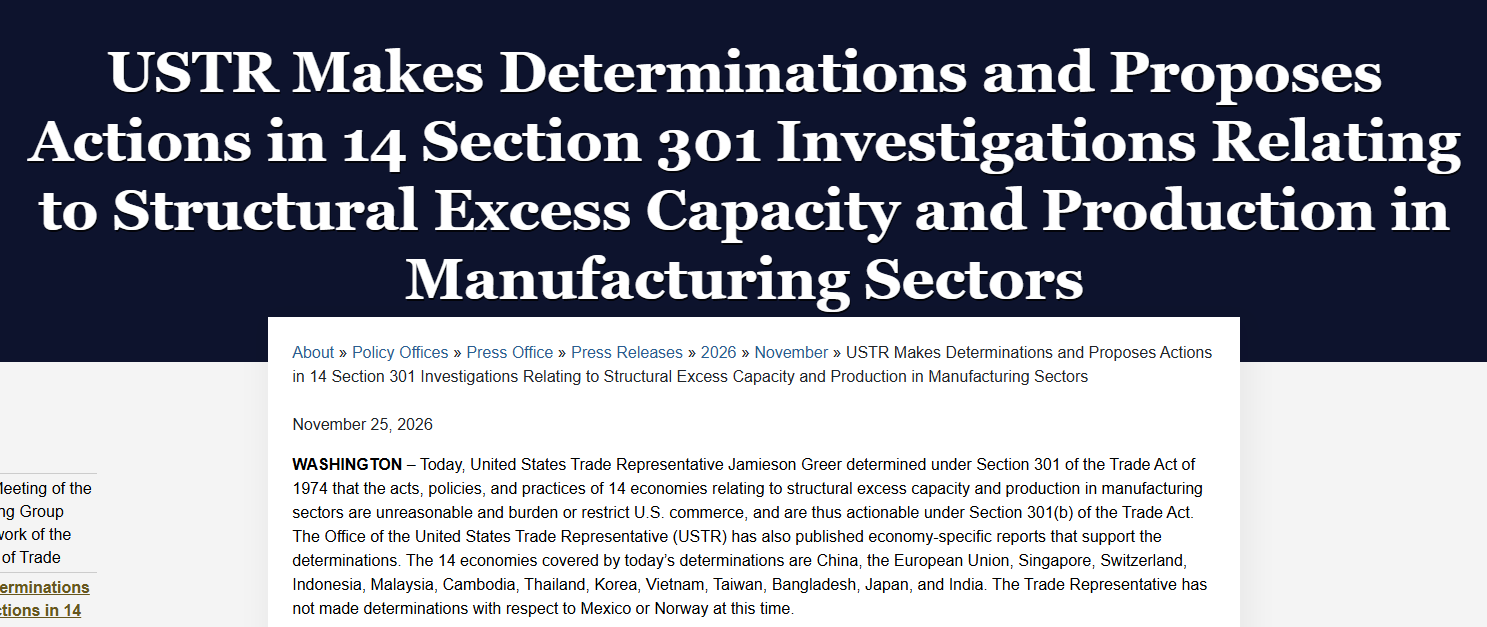
The tariffs have not yet officially taken effect, and customers' shipping plans may have already begun to be affected.
If importers are worried about the tax rate increase next year, they may choose to arrange shipments in advance to complete imports before the new measures are implemented; some customers may also postpone orders and wait for the outcome of Sino-US negotiations.
Both of these situations will affect the freight forwarder’s booking rhythm.
In the short term, some customers in the U.S. may focus on shipments while others wait and see. The details will depend on subsequent policy progress and actual cargo volume.
In addition, origin review cannot be ignored.Especially for goods produced in China and transshipped in Southeast Asia, it is best for freight forwarders to remind customers in advance to verify the country of origin and related documents to avoid discovering problems with customs clearance documents only after the goods arrive in the United States.There are still key points in January. At present, this round of tariffs is still in the proposed stage.
According to the arrangements announced by USTR, the deadline for submitting written opinions on China’s special measures is January 5, 2027, and a public hearing is scheduled to be held on January 25.
The Sino-US trade truce agreement will also expire in January 2027.
The arrival of two time nodes one after another means that there is still room for adjustment in U.S. tariff policy in the next two months.
For Chinese freight forwarders, it is not yet easy to judge whether U.S. freight rates will rise or fall as a result, but the pace of customer shipments, product origin review and customs clearance costs are all worthy of early attention.
After all, it is one thing to decide who will ultimately bear the tariffs; it is another thing to say whether the goods can smoothly enter the US market.
On November 25, local time, the Office of the United States Trade Representative (USTR) announced that it would propose a new round of tariff measures against 14 economies including China, the European Union, Japan, South Korea, and India, on the grounds that these economies have manufacturing overcapacity problems.
Among them, Chinese products are planned to be subject to tariffs of up to 20%.If the trade truce previously reached by China and the United States fails to be extended, the tax rate may even rise to 40%.
Although the new tariffs have not yet been officially implemented, the United States clearly has no plans to relax trade restrictions this time.For freight forwarders who are doing business in the United States, there will be another round of policy changes that need to be paid attention to.
The Supreme Court rejects the old tariffs, and the United States adopts a new approach
From the official website of the Office of the United States Trade Representative
Behind this round of tariffs, there is still a legal battle.
In February this year, the U.S. Supreme Court ruled that the extensive tariff measures previously implemented by the Trump administration under the International Emergency Economic Powers Act (IEEPA) lacked legal basis.
After the old approach was blocked, the U.S. government quickly turned to Section 301 of the Trade Act of 1974.
In March this year, USTR launched an investigation into the manufacturing overcapacity problem in multiple economies.After several months of investigation, the investigation and determination were officially announced on November 25, and a new round of tariffs was proposed.
Unlike the previous direct use of emergency powers to raise taxes, this time the United States is trying to find a legal basis for new tariff measures through trade investigation procedures.
To put it bluntly, the door to tariffs has not been closed, but a key has been changed.
The maximum 20% for Chinese goods may rise to 40% if the agreement breaks down
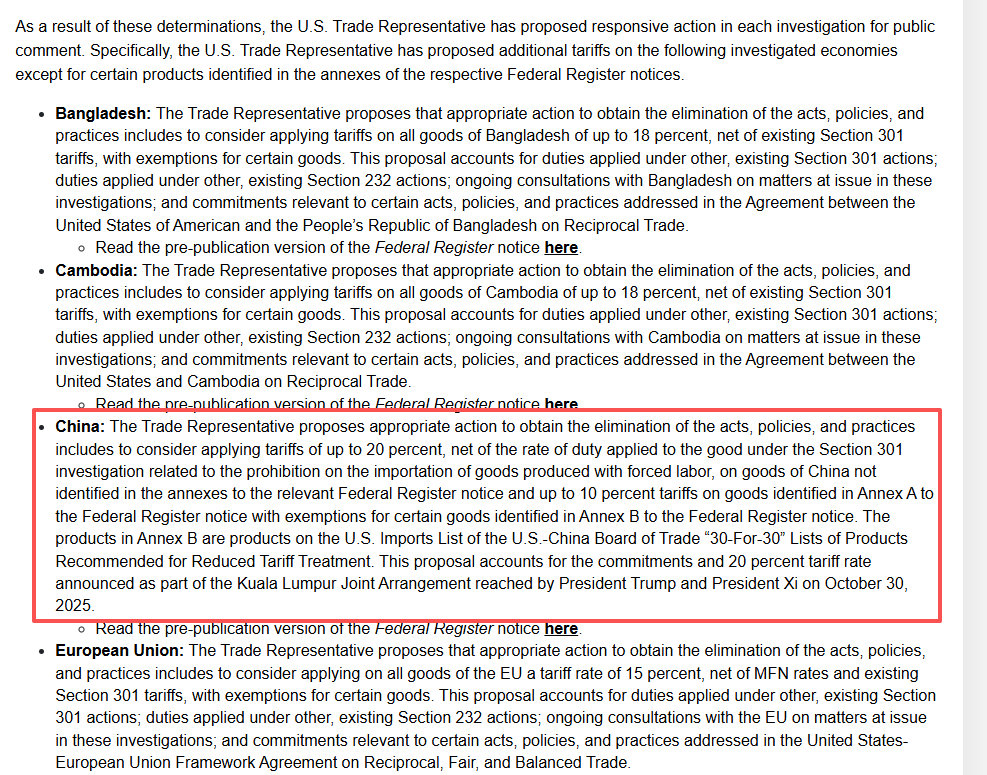
From the official website of the Office of the United States Trade Representative, China is getting the most attention this time.
According to the plan announced by the United States, Chinese goods are planned to be subject to new tariffs of up to 20%.If the Sino-US trade truce cannot be extended, the tax rate may further rise to 40%.
It should be noted that this does not mean that all Chinese products are subject to a uniform 20% levy.The specific tax burden also depends on the product tax code, existing tariffs and related exemption arrangements.
Currently, the trade truce previously reached by China and the United States is expected to expire in January 2027.
U.S. Trade Representative Greer said that if the U.S. raises the tax rate to more than 20%, China may consider the U.S. to have violated the previous trade agreement.
Chinese Foreign Ministry spokesperson Guo Jiakun also responded on November 25 that tariff wars and trade wars are not in the interests of either party. He hopes that both sides will implement the important consensus reached by the two heads of state and maintain the stability of economic and trade relations.
At present, while the United States is proposing a new tax increase plan, it is also considering whether the Sino-US trade truce can be maintained.The outcome of the subsequent negotiations between the two parties will directly affect the direction of tariffs on Chinese goods exported to the United States.
01 Not only China, but Southeast Asia is also included in the investigation. The tariff measures proposed by the United States involve a total of 14 economies, including China, the European Union, Japan, South Korea, India, Vietnam, Thailand, Malaysia, Indonesia, Singapore, Cambodia, Bangladesh, Taiwan, China, and Switzerland.
Among them, Vietnam's proposed tax rate can reach up to 35%, India can reach up to 25%, and economies such as Japan and South Korea are also facing new tariff arrangements.
This is also not easy news for export companies that have been actively deploying in Southeast Asia in recent years.
In the past, some companies moved their production links to Vietnam, Thailand and other places, hoping to reduce their dependence on a single production base.However, this U.S. investigation also includes issues such as transshipment in third countries.
If goods made in China are simply transferred to a third country without substantial production changes that comply with the rules of origin, US tariffs cannot be avoided.
For freight forwarders, for orders involving Southeast Asian production, transshipment and U.S. imports, they need to pay more attention to the certificate of origin, production records and customs declaration information.
American freight forwarding lines have to face new uncertainties
The tariffs have not yet officially taken effect, and customers' shipping plans may have already begun to be affected.
If importers are worried about the tax rate increase next year, they may choose to arrange shipments in advance to complete imports before the new measures are implemented; some customers may also postpone orders and wait for the outcome of Sino-US negotiations.
Both of these situations will affect the freight forwarder’s booking rhythm.
In the short term, some customers in the U.S. may focus on shipments while others wait and see. The details will depend on subsequent policy progress and actual cargo volume.
In addition, origin review cannot be ignored.Especially for goods produced in China and transshipped in Southeast Asia, it is best for freight forwarders to remind customers in advance to verify the country of origin and related documents to avoid discovering problems with customs clearance documents only after the goods arrive in the United States.There are still key points in January. At present, this round of tariffs is still in the proposed stage.
According to the arrangements announced by USTR, the deadline for submitting written opinions on China’s special measures is January 5, 2027, and a public hearing is scheduled to be held on January 25.
The Sino-US trade truce agreement will also expire in January 2027.
The arrival of two time nodes one after another means that there is still room for adjustment in U.S. tariff policy in the next two months.
For Chinese freight forwarders, it is not yet easy to judge whether U.S. freight rates will rise or fall as a result, but the pace of customer shipments, product origin review and customs clearance costs are all worthy of early attention.
After all, it is one thing to decide who will ultimately bear the tariffs; it is another thing to say whether the goods can smoothly enter the US market.