

The US East has soared to $10,046!The European line continues to fall!Will the market reverse in Sep
- Author:Maintenance network
- Source:Maintenance network
- Release Date:2026-08-31
Recently, the Shanghai Export Container Freight Index (SCFI) rose to 3509.53 points, rising for the fifth consecutive week.Among them, the freight rate for 40-foot containers on the East US route reached US$10,046, regaining US$10,000; the European route continued to fall.At the same time, the Panama Canal will further tighten traffic arrangements in September, and shipping companies have begun to pass on some of the new costs through surcharges and other methods.Entering September, which routes will continue to increase and which routes may continue to be under pressure are becoming the focus of freight forwarding and export companies.
US East regains $10,000 mark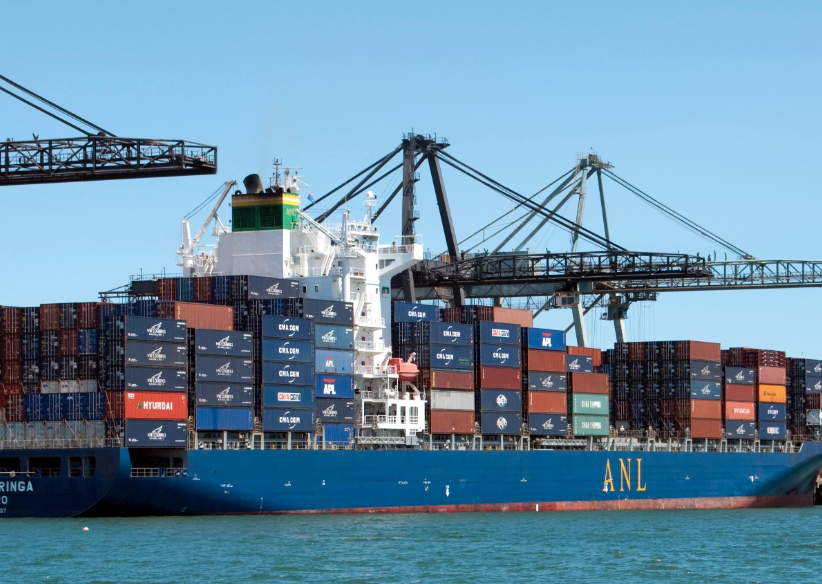
Let’s first look at the US-Eastern route that has received the most market attention.The latest SCFI data released by the Shanghai Shipping Trading Research Institute on August 28 showed that the freight rate on the US East Route was US$10,046/FEU, an increase of 3.6% from the previous period; the US West Route also rose to US$6,940/FEU.This has been a period of continuous strength for North American routes.According to data released by Xeneta on August 21, the average spot freight rate from the Far East to the US East has reached 10,527 US dollars/FEU, an increase of 2.8% in a week; the Far East to the US West is 7,193 US dollars/FEU, also rising.In other words, although different indexes have different statistical calibers, their directions are relatively consistent: North American routes are still at a high level.For freight forwarders and cargo owners, a more direct change is that when booking space in September, the quotation for the US East route can no longer be measured by the previous price level.
01The Panama Canal tightened the US-Eastern route again in September. Why is it still rising?The Panama Canal is becoming an inevitable factor.In late August, the Panama Canal Authority announced that due to lower-than-expected precipitation in the canal basin and the impact of El Niño, it would further adjust the lock capacity in September.According to an announcement from the Administration, starting from September 3, the daily quota for the Neopanamax lock will be adjusted to 9 and the Panamax lock will be 25; starting from September 15, the daily quota for the Panamax lock will be further reduced to 23.This means that the total daily traffic will further drop from 34 to 32.For container ships from Asia to the East Coast of the United States, after capacity is restricted, ship waiting, route arrangements and effective transportation capacity will be affected.And this impact has begun to be reflected in shipping company charges.MSC announced on August 12 that starting from gate-in on September 12, the Panama Canal surcharges from Asia to the East Coast of the United States and the U.S. Gulf region will be adjusted to: US$149 for 20-foot containers, US$297 for 40-foot containers, and US$376 for 45-foot containers.MSC said continued draft restrictions are reducing ship capacity on the Panama Canal route.CMA CGM also announced an adjustment plan on August 11. Starting from September 10, a Panama Canal Adjustment Factor of US$500/TEU will be levied on related goods from the Far East to the East Coast of the United States and the US Gulf region.This means that in September, the US Eastern Route will not only face changes in basic sea freight rates, but also canal surcharges may further push up actual transportation costs.
The European line has a different trend.
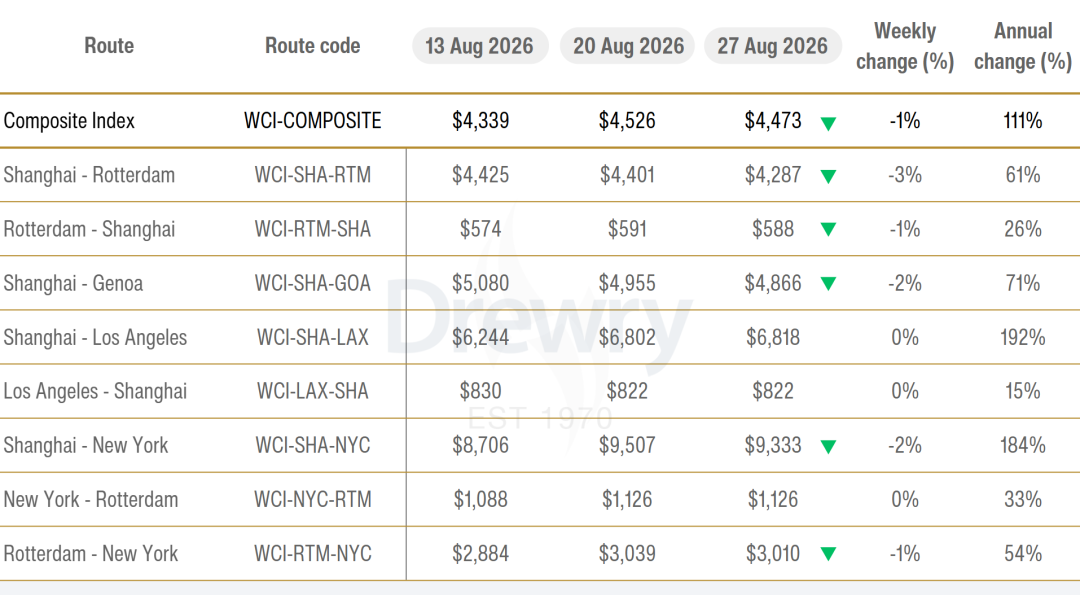
The picture comes from Drewry. North American routes are rising, but European routes have not kept up.SCFI data on August 28 showed that the freight rate from Shanghai to the European basic port dropped to 2,716 US dollars/TEU, continuing to decline from the previous period; the Mediterranean route dropped to 3,557 US dollars/TEU.The latest World Container Index released by Drewry on August 27 also showed that the spot freight rate for a 40-foot container from Shanghai to Rotterdam was US$4,287, a weekly decrease of 3%; that from Shanghai to Genoa was US$4,866, a weekly decrease of 2%.The Drewry Composite Index also fell 1% to $4,473/FEU.Xeneta's data on August 21 is more intuitive: the average spot freight rate from the Far East to Northern Europe was 4,801 US dollars/FEU, a weekly decrease of 2.8%; the Far East to the Mediterranean was 5,526 US dollars/FEU, a weekly decrease of 3.8%.During the same period, prices from the Far East to the US East increased by 2.8%.On the one hand, the US East Coast continues to move above US$10,000, and on the other hand, the European routes continue to fall.This difference is no longer just a single-week rise or fall, but has gradually become an important feature of the current container shipping market.
There is another variable in September: ports and capacity
In addition to canal factors, the market in September also faces variables such as port congestion, weather, and shipping company capacity adjustments.Drewry pointed out in the latest weekly analysis released on August 28 that after entering September, there are still 45 empty flight plans on major east-west routes, accounting for about 6% of planned flights.Meanwhile, congestion at major Asian ports, weather disturbances and Panama Canal restrictions continue to impact route operations.This means that even if shipping companies increase or adjust part of their shipping capacity, the increase in shipping capacity does not necessarily mean that shipping schedules and market prices can immediately return to stability.Especially recently, Asian ports have been affected by typhoon weather, and some shipping schedules and port operations have been adjusted.After entering September, if port backlogs, shipping schedule adjustments and canal restrictions are superimposed, the actual available space on some routes may still fluctuate.
Industry Observation Judging from the data that has been released so far, there is a high probability that all routes will not rise or fall simultaneously in the container shipping market in September.The U.S. East Line needs to focus on the Panama Canal traffic arrangements and changes in shipping company surcharges; the U.S. West Line is still at a relatively high level, and it is necessary to pay attention to peak season cargo volume changes and shipping companies' subsequent capacity arrangements; the European Line still faces downward pressure on spot prices, and you can pay more attention to the price and space differences between different shipping companies when booking space.For freight forwarders and export companies, they cannot just look at a "market price" when quoting and booking space.Basic shipping charges, Panama Canal surcharges, shipping schedules, and actual available space may directly affect the final cost.The most noteworthy thing at present is not "whether ocean freight will rise across the board", but that in the same market, the Eastern United States and Europe are developing two completely different price curves.Whether this differentiation can continue in September will depend on cargo volumes, capacity and port and canal operations.Judging from the data that has been released so far, there is a high probability that all routes will not rise or fall simultaneously in the container shipping market in September.
US East regains $10,000 mark
Let’s first look at the US-Eastern route that has received the most market attention.The latest SCFI data released by the Shanghai Shipping Trading Research Institute on August 28 showed that the freight rate on the US East Route was US$10,046/FEU, an increase of 3.6% from the previous period; the US West Route also rose to US$6,940/FEU.This has been a period of continuous strength for North American routes.According to data released by Xeneta on August 21, the average spot freight rate from the Far East to the US East has reached 10,527 US dollars/FEU, an increase of 2.8% in a week; the Far East to the US West is 7,193 US dollars/FEU, also rising.In other words, although different indexes have different statistical calibers, their directions are relatively consistent: North American routes are still at a high level.For freight forwarders and cargo owners, a more direct change is that when booking space in September, the quotation for the US East route can no longer be measured by the previous price level.
01The Panama Canal tightened the US-Eastern route again in September. Why is it still rising?The Panama Canal is becoming an inevitable factor.In late August, the Panama Canal Authority announced that due to lower-than-expected precipitation in the canal basin and the impact of El Niño, it would further adjust the lock capacity in September.According to an announcement from the Administration, starting from September 3, the daily quota for the Neopanamax lock will be adjusted to 9 and the Panamax lock will be 25; starting from September 15, the daily quota for the Panamax lock will be further reduced to 23.This means that the total daily traffic will further drop from 34 to 32.For container ships from Asia to the East Coast of the United States, after capacity is restricted, ship waiting, route arrangements and effective transportation capacity will be affected.And this impact has begun to be reflected in shipping company charges.MSC announced on August 12 that starting from gate-in on September 12, the Panama Canal surcharges from Asia to the East Coast of the United States and the U.S. Gulf region will be adjusted to: US$149 for 20-foot containers, US$297 for 40-foot containers, and US$376 for 45-foot containers.MSC said continued draft restrictions are reducing ship capacity on the Panama Canal route.CMA CGM also announced an adjustment plan on August 11. Starting from September 10, a Panama Canal Adjustment Factor of US$500/TEU will be levied on related goods from the Far East to the East Coast of the United States and the US Gulf region.This means that in September, the US Eastern Route will not only face changes in basic sea freight rates, but also canal surcharges may further push up actual transportation costs.
The European line has a different trend.
The picture comes from Drewry. North American routes are rising, but European routes have not kept up.SCFI data on August 28 showed that the freight rate from Shanghai to the European basic port dropped to 2,716 US dollars/TEU, continuing to decline from the previous period; the Mediterranean route dropped to 3,557 US dollars/TEU.The latest World Container Index released by Drewry on August 27 also showed that the spot freight rate for a 40-foot container from Shanghai to Rotterdam was US$4,287, a weekly decrease of 3%; that from Shanghai to Genoa was US$4,866, a weekly decrease of 2%.The Drewry Composite Index also fell 1% to $4,473/FEU.Xeneta's data on August 21 is more intuitive: the average spot freight rate from the Far East to Northern Europe was 4,801 US dollars/FEU, a weekly decrease of 2.8%; the Far East to the Mediterranean was 5,526 US dollars/FEU, a weekly decrease of 3.8%.During the same period, prices from the Far East to the US East increased by 2.8%.On the one hand, the US East Coast continues to move above US$10,000, and on the other hand, the European routes continue to fall.This difference is no longer just a single-week rise or fall, but has gradually become an important feature of the current container shipping market.
There is another variable in September: ports and capacity
In addition to canal factors, the market in September also faces variables such as port congestion, weather, and shipping company capacity adjustments.Drewry pointed out in the latest weekly analysis released on August 28 that after entering September, there are still 45 empty flight plans on major east-west routes, accounting for about 6% of planned flights.Meanwhile, congestion at major Asian ports, weather disturbances and Panama Canal restrictions continue to impact route operations.This means that even if shipping companies increase or adjust part of their shipping capacity, the increase in shipping capacity does not necessarily mean that shipping schedules and market prices can immediately return to stability.Especially recently, Asian ports have been affected by typhoon weather, and some shipping schedules and port operations have been adjusted.After entering September, if port backlogs, shipping schedule adjustments and canal restrictions are superimposed, the actual available space on some routes may still fluctuate.
Industry Observation Judging from the data that has been released so far, there is a high probability that all routes will not rise or fall simultaneously in the container shipping market in September.The U.S. East Line needs to focus on the Panama Canal traffic arrangements and changes in shipping company surcharges; the U.S. West Line is still at a relatively high level, and it is necessary to pay attention to peak season cargo volume changes and shipping companies' subsequent capacity arrangements; the European Line still faces downward pressure on spot prices, and you can pay more attention to the price and space differences between different shipping companies when booking space.For freight forwarders and export companies, they cannot just look at a "market price" when quoting and booking space.Basic shipping charges, Panama Canal surcharges, shipping schedules, and actual available space may directly affect the final cost.The most noteworthy thing at present is not "whether ocean freight will rise across the board", but that in the same market, the Eastern United States and Europe are developing two completely different price curves.Whether this differentiation can continue in September will depend on cargo volumes, capacity and port and canal operations.Judging from the data that has been released so far, there is a high probability that all routes will not rise or fall simultaneously in the container shipping market in September.