

Shipping warning!6 cruises canceled overnight!MSC has made major adjustments to its shipping capacit
Global shipping giant Mediterranean Shipping Company (MSC) issued two customer announcements on August 24 and 26, confirming that it would cancel 6 Asian export trunk voyages around the National Day Golden Week, involving 4 Asia-Europe routes and 2 US-Western routes.This adjustment is concentrated in the shipping window period from the 39th to the 41st week, which accurately corresponds to the traditional time period when domestic factories are shut down and export volume declines. It is a planned suspension of operations that has been relatively intensive recently.
Official announcement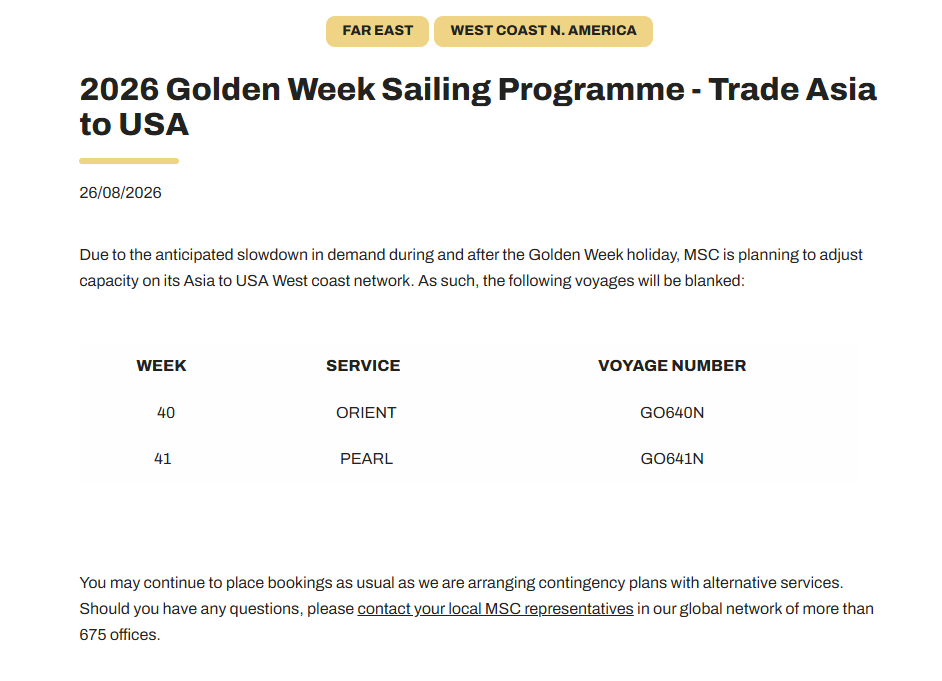
According to MSC’s official announcement, the canceled voyages from Asia to Europe include: JADE route (GJ639W) in the 39th week, SWAN route (FW640W) and BRITANNIA route (QB640W) in the 40th week, and LION route (GL641W) in the 41st week.The canceled voyages from Asia to the West are: ORIENT route in the 40th week (GO640N, calling Qingdao/Ningbo/Shanghai/Busan-Long Beach) and PEARL route (GO641N, calling Yantian/Xiamen-Long Beach) in the 41st week.MSC stated that this adjustment is based on the prediction that market demand will slow down during and around the Golden Week. Customers can still book space normally. All goods from canceled voyages will be allocated to nearby alternative voyages for shipment. However, shipping schedules and customs cut-off times will change accordingly, and the original time limit cannot be guaranteed to remain unchanged.
The risk of space runs increases
Freightos analyst Judah Levine pointed out that the advance stocking triggered by this year's tariff window has prompted some importers to advance inventory. The traditional pre-holiday rush shipment peak has been flattened, and shipping companies have chosen to suspend sailings to match actual cargo volumes instead of maintaining empty cabin operations.Industry insiders analyze that the cargo originally diverted from the six voyages will be squeezed into surrounding voyages that have not been cancelled. There will be a periodic shortage of space in popular routes and main ports.Affected by this, the sailing and arrival time of most goods is expected to be delayed by 3 to 7 days. The tight space will increase the freight rate to a certain extent, ending the continuous decline in freight rates before the holiday.If leading shipping companies such as Maersk, CMA CGM, and Hapag-Lloyd follow suit and suspend sailings, the effective shipping capacity in the Asia-Europe and U.S.-West directions will be further tightened from late September to mid-October.
There is another variable in September: ports and capacity
Freight forwarding companies need to comprehensively check MSC booking orders from late September to early October to check whether they involve canceled voyages, synchronize customer update information as soon as possible, and manage expectations well.Lock in the spare space of other shipping companies in advance and build a double insurance shipping plan to avoid being temporarily dumped when the alternative voyage is full.At the same time, the trailer and customs declaration teams are synchronized in a timely manner, and customs cutoff and shipping times are updated to prevent additional miscellaneous fees due to changes in shipping schedules after the goods enter the port.For orders with tight delivery dates, foreign traders should try their best to arrange shipments in advance to avoid the window period for capacity adjustment.Timely contact overseas customers to update the estimated arrival time, and reserve a logistics buffer period of about one week to avoid customer complaints caused by delayed delivery.Before shipment, be sure to confirm with the freight forwarder the alternative voyage information, clarify the new shipping date and cut-off point, and stabilize the order delivery rhythm.MSC's proactive suspension of sailings this time is essentially a defensive strategy for shipping companies to lock in freight rates and avoid empty space losses before the off-season. It is not a signal of demand recovery.However, this operation will create a situation of "artificial shortage of shipping space" in the short term, and combined with some rush shipment demand before the holidays, it is difficult for freight rates to fall significantly in the short term.Cargo owners should not blindly wait and see and bet on the decline. They need to be pragmatic in their shipping plans for existing orders and maintain high-frequency communication with freight forwarders to avoid confusion in trailers, customs declarations, storage and other links due to changes in shipping schedules, and incur additional costs such as container detention and relocation.
Official announcement
According to MSC’s official announcement, the canceled voyages from Asia to Europe include: JADE route (GJ639W) in the 39th week, SWAN route (FW640W) and BRITANNIA route (QB640W) in the 40th week, and LION route (GL641W) in the 41st week.The canceled voyages from Asia to the West are: ORIENT route in the 40th week (GO640N, calling Qingdao/Ningbo/Shanghai/Busan-Long Beach) and PEARL route (GO641N, calling Yantian/Xiamen-Long Beach) in the 41st week.MSC stated that this adjustment is based on the prediction that market demand will slow down during and around the Golden Week. Customers can still book space normally. All goods from canceled voyages will be allocated to nearby alternative voyages for shipment. However, shipping schedules and customs cut-off times will change accordingly, and the original time limit cannot be guaranteed to remain unchanged.
The risk of space runs increases
Freightos analyst Judah Levine pointed out that the advance stocking triggered by this year's tariff window has prompted some importers to advance inventory. The traditional pre-holiday rush shipment peak has been flattened, and shipping companies have chosen to suspend sailings to match actual cargo volumes instead of maintaining empty cabin operations.Industry insiders analyze that the cargo originally diverted from the six voyages will be squeezed into surrounding voyages that have not been cancelled. There will be a periodic shortage of space in popular routes and main ports.Affected by this, the sailing and arrival time of most goods is expected to be delayed by 3 to 7 days. The tight space will increase the freight rate to a certain extent, ending the continuous decline in freight rates before the holiday.If leading shipping companies such as Maersk, CMA CGM, and Hapag-Lloyd follow suit and suspend sailings, the effective shipping capacity in the Asia-Europe and U.S.-West directions will be further tightened from late September to mid-October.
There is another variable in September: ports and capacity
Freight forwarding companies need to comprehensively check MSC booking orders from late September to early October to check whether they involve canceled voyages, synchronize customer update information as soon as possible, and manage expectations well.Lock in the spare space of other shipping companies in advance and build a double insurance shipping plan to avoid being temporarily dumped when the alternative voyage is full.At the same time, the trailer and customs declaration teams are synchronized in a timely manner, and customs cutoff and shipping times are updated to prevent additional miscellaneous fees due to changes in shipping schedules after the goods enter the port.For orders with tight delivery dates, foreign traders should try their best to arrange shipments in advance to avoid the window period for capacity adjustment.Timely contact overseas customers to update the estimated arrival time, and reserve a logistics buffer period of about one week to avoid customer complaints caused by delayed delivery.Before shipment, be sure to confirm with the freight forwarder the alternative voyage information, clarify the new shipping date and cut-off point, and stabilize the order delivery rhythm.MSC's proactive suspension of sailings this time is essentially a defensive strategy for shipping companies to lock in freight rates and avoid empty space losses before the off-season. It is not a signal of demand recovery.However, this operation will create a situation of "artificial shortage of shipping space" in the short term, and combined with some rush shipment demand before the holidays, it is difficult for freight rates to fall significantly in the short term.Cargo owners should not blindly wait and see and bet on the decline. They need to be pragmatic in their shipping plans for existing orders and maintain high-frequency communication with freight forwarders to avoid confusion in trailers, customs declarations, storage and other links due to changes in shipping schedules, and incur additional costs such as container detention and relocation.