

Shipping companies no longer have the final say in rejecting cabins and dumping containers!The U.S.
- Author:Maintenance network
- Source:Maintenance network
- Release Date:2026-11-18
The U.S. seaborne export business has another regulatory requirement.In the past, when freight forwarders and exporters booked space, the biggest headaches were often temporary adjustments in freight rates by shipping companies, tight space, insufficient empty containers, and unequal rules for export booking and import booking.Now, the U.S. Federal Maritime Commission (FMC) has begun to further regulate shipping companies’ export business policies, requiring shipping companies to submit these rules in writing to the regulatory agency.This time, it is not just about submitting a simple business description. How to set freight rates, when to adjust surcharges, how to allocate shipping spaces, and how to deploy empty containers are all included in the scope of supervision.Shipping companies, which used to have relatively flexible export booking policies, will face clearer disclosure and regulatory requirements in the future.
Shipping companies must submit materials before March 1, 2019
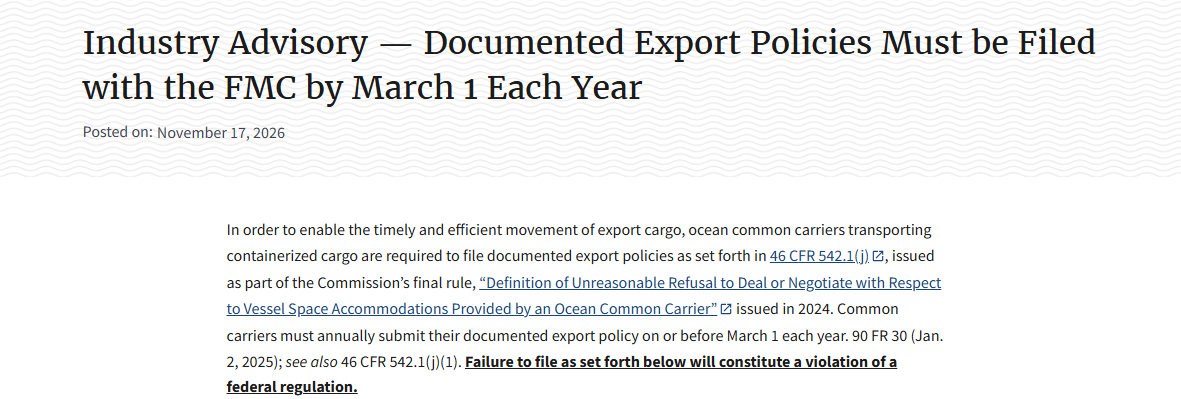
On November 17, 2026 local time, the U.S. Federal Maritime Commission (FMC) issued the latest industry notice, clarifying the specific requirements for shipping companies to submit annual export policy documents.According to the content announced by the FMC, all ocean common carriers transporting containerized goods must submit a written export policy document to the FMC on or before March 1 every year.This is not a newly proposed initiative, but a further implementation after the previous regulatory rules have been formally implemented.The key thing is that this time the FMC requires submissions that go far beyond freight rates and routes, and instead includes all the most controversial aspects of the export business within the scope of review.
01How to determine the freight price and how to charge the surcharge?
The first is the freight rate issue that freight forwarders and cargo owners are most concerned about.The FMC requires shipping companies to explain their pricing strategies for export slots, including spot freight rates, tariffs and pricing basis for service contracts.Specifically, shipping companies need to explain several questions: How much impact does ship operating cost have on freight rates?How does ship space utilization affect the quotation?How do container inventories, empty container shipping costs and trade imbalances affect prices?How are these factors ultimately reflected in export freight rates?Will customers be notified in advance before adjusting sea freight, surcharges and other charges?How far in advance?These questions actually correspond to situations that freight forwarders often encounter when booking space on a daily basis.For example, why are the quotes obtained at different times for the same route very different?Why do export prices rise when there is a shortage of empty containers at some ports?Why do freight forwarders often not have much preparation time when shipping companies adjust surcharges?In the past, freight forwarders relied more on market quotations and actual booking results to judge the operating strategies of shipping companies.Now, the FMC requires shipping companies to formulate these pricing bases and adjustment mechanisms into written policies.It should be noted that FMC does not require shipping companies to fix freight rates, nor does it directly stipulate the increase or decrease of surcharges.The focus of supervision is to require shipping companies to explain pricing logic and what kind of notification customers can get before price adjustments.02 Export space cannot only depend on import business. The second requirement involves route layout and export booking services.Shipping companies must describe which export markets they cover, which routes they operate, the frequency of ships on each route, and whether alternative routes or other transportation services exist.At the same time, the FMC specifically requires shipping companies to explain the negotiation and acceptance conditions for export bookings, especially when there are different rules between export business and import business, explanations must be made.This is very pertinent.In international container transportation, shipping companies usually need to balance space, container sources and ship turnover between imported goods and export goods.For the U.S. export market, some routes also involve the return of empty containers, trade imbalances and equipment deployment between different ports.When market capacity is tight, how do shipping companies arrange export cargo?When an export booking application is rejected, is there no available space or are there other business restrictions?These need to be stated in the export policy.What FMC wants to know is not only whether the shipping company provides export services, but also how it arranges export space and whether export customers can get fair and reasonable booking opportunities.03 Empty containers, suspension of sailings and refusal of carriage all indicate that among the newly announced document requirements, there are several contents closely related to the daily operations of freight forwarders.One is empty box supply.Shipping companies need to explain how they decide on the supply, allocation and movement of containers, including how empty container inventories are monitored, how they are allocated between different markets, and how equipment shortages are handled.If there is a shortage of empty containers at a certain port, the shipping company needs to explain how this situation will affect export bookings and what early warning and response measures are in place.The second is to cancel the voyage.Shipping companies must explain the definition of canceled voyages, implementation policies, how far in advance they will notify customers before canceling a voyage, and through what channels the notification will be issued.For export cargo that has been booked, shipping companies also need to explain what remedial arrangements are in place and how to deal with the knock-on impact on subsequent shipping schedules and operations after canceling a voyage.This is especially important for freight forwarders.The cancellation of a flight on a route will not only affect the cabin space for that week.The cargo may need to be rerouted to the next ship, and the original towing, port entry, customs clearance and customer delivery arrangements may also be adjusted accordingly.In the past, freight forwarders often had to temporarily find alternative shipping dates when encountering suspension notices.Now, FMC requires shipping companies to write relevant notification mechanisms and remedial measures into policy documents in advance.The third is empty container shipping vessels (Sweeper Vessels).The FMC also specifically requires shipping companies to explain the rules for the use of such ships.As defined in regulatory documents, the Sweeper Vessel is a vessel specifically designed to load empty containers from U.S. ports and transport them to other designated locations.Shipping companies are required to describe the designation criteria, usage policies and related performance targets for such vessels.This requirement is directly related to the issue of empty container supply in the US export market.For exporters, whether empty containers can be transferred in time is often more practical than whether there is a quotation on the market.The fourth is to reject alternatives after booking.If the export cargo owner is denied space, the shipping company also needs to explain what alternative space or assistance measures can be provided, including under what circumstances these arrangements will be provided, and through what channels customers should apply for help.In other words, FMC not only requires shipping companies to explain why there is no space, but also requires them to explain what they can do for export customers after they refuse to book space.
02What Chinese freight forwarders really want to look at is this
Seeing this, some people may ask: What is the direct relationship between FMC's requirement for shipping companies to submit materials and Chinese freight forwarders?Indeed, the direct declaration subject of this regulation is not the Chinese freight forwarder, but the relevant maritime common carrier.But what Chinese freight forwarders undertake in large quantities is precisely the US export routes of these shipping companies.Therefore, the impact will not be directly reflected in "the freight forwarder also has to submit a copy of the materials", but is more likely to be reflected in the booking rules and business communication methods.Take the simplest example.In the future, when Chinese freight forwarders are denied export bookings for U.S. lines, if the reason given by the shipping company is "no space," it is not just a verbal reply from a salesperson.FMC requires shipping companies to formulate export policies in advance, including export booking conditions, equipment supply, canceled voyages, and alternative arrangements after being denied a booking.This is equivalent to giving the freight forwarder an extra ruler.Of course, this ruler is not used to demand that shipping companies "must give me cabins."The FMC clearly stated in the 2024 final rules that the submission of export policies by shipping companies does not mean that every subsequent operation must be carried out mechanically in accordance with the documents; however, whether a shipping company follows its own export policies can be a reference factor when the FMC determines whether it has unreasonable behavior.This is more critical.If there are obvious problems such as denial of cargo, space disputes, and equipment shortages on the U.S. line in the future, the freight forwarder can at least look at what actually happened and the shipping company's own export policy.This is much more grounded than relying solely on the salesman's "This is what the company has stipulated now" in the past.The first thing that Chinese freight forwarders may feel is that the "rule transparency" policy will not cause China's freight rates for exporting to the United States to suddenly drop in the short term, nor will it allow shipping companies to suddenly add a large number of shipping spaces.FMC also does not require shipping companies to fix freight rates.But it may change a very practical thing: how transparent the rules are for shipping companies when facing export customers.Especially when freight rates are adjusted, empty containers are insufficient, space is tight, and blank sailing occurs frequently, what freight forwarders fear most is not high prices, but unclear rules.Today it says there is space, but tomorrow it says there is no space; today’s quotation is valid, but two days later the surcharge changes; the shipping date is cancelled, but I don’t know how the goods will be arranged.For Chinese freight forwarders operating on the US line, if they encounter more difficult booking issues in the future, it will be more important than before to keep records of quotations, booking applications, refusal notices, surcharge adjustment notices, suspension notices and equipment shortages.Because once a dispute arises, the real value is often not "the shipping company said so at the time", but: what happened at that time, how the shipping company explained it, and how its own rules were written.
03Chinese freight forwarders should keep an eye on their own shipping space
This rule actually has a background that is easily overlooked.In July 2024, the FMC officially issued final rules for "unreasonable refusal to provide or negotiate ship space"; on January 2, 2025, the rules were published in the U.S. Federal Register.On November 17, 2026, FMC further clarified the specific requirements for annual export policy declaration.Judging from this timeline, the United States’ supervision of shipping export bookings is gradually being refined.For Chinese freight forwarders, there is no need to understand this as the United States has added another regulation that has nothing to do with itself.A more practical view is: in the future, when doing American lines, in addition to paying attention to freight rates and shipping spaces, we must also start to pay attention to the rules of the shipping company.Especially when the market experiences tight space, insufficient container supply, shipping schedule adjustments or large-scale blank sailing, whose rules are clearer and whose alternatives are clearer will directly affect how freight forwarders arrange goods for customers.Of course, a shipping company is still a shipping company, and a freight forwarder is still a freight forwarder.But on the U.S. export side, the “business rules” between the two parties that used to be relatively vague are being written down on paper bit by bit by regulatory agencies.