

Rumor has it that "thousands of cabinets have been seized" from Meihui Coil!Can I still bo
- Author:Maintenance network
- Source:Maintenance network
- Release Date:2026-09-23
In recent days, there has been significantly more discussion in the U.S. customs clearance circle.
Many industry channels and logistics practitioners have reported that a batch of containers have been detained and delayed in customs clearance at some ports in the United States. There are even rumors circulating in the market that "thousands of containers have been affected." Some news further claims that Chinese export goods and BCO direct passenger goods are involved.
However, so far, CBP has not publicly confirmed the official statistics of "thousands" or "3,000 Chinese containers detained", nor has it released the so-called list of freight forwarders or IORs involved.
Therefore, this number is currently more suitable to be regarded as industry rumors rather than officially confirmed facts.
The changes that have actually taken place are another matter.
Starting from September 18, the U.S. Customs and Border Protection (CBP) officially launched enhanced verification of Importer of Record (IOR) information.
01
Many industry channels and logistics practitioners have reported that a batch of containers have been detained and delayed in customs clearance at some ports in the United States. There are even rumors circulating in the market that "thousands of containers have been affected." Some news further claims that Chinese export goods and BCO direct passenger goods are involved.
However, so far, CBP has not publicly confirmed the official statistics of "thousands" or "3,000 Chinese containers detained", nor has it released the so-called list of freight forwarders or IORs involved.
Therefore, this number is currently more suitable to be regarded as industry rumors rather than officially confirmed facts.
The changes that have actually taken place are another matter.
Starting from September 18, the U.S. Customs and Border Protection (CBP) officially launched enhanced verification of Importer of Record (IOR) information.
01
IOR starts on September 18th
Being re-identified
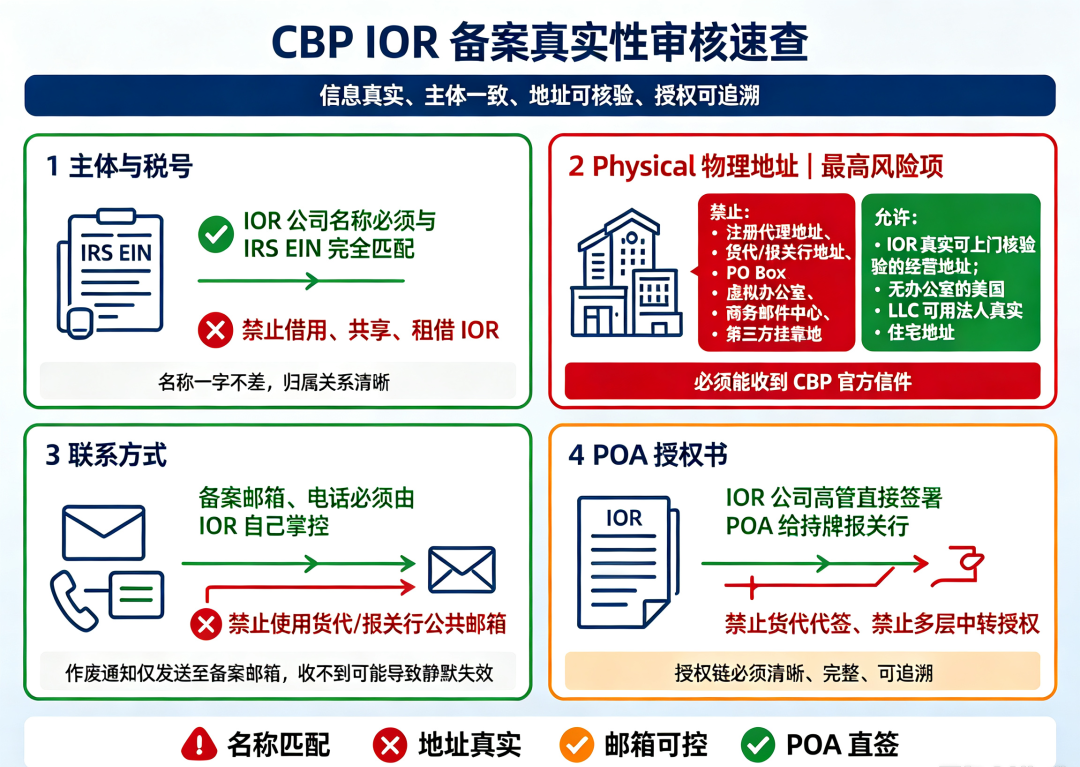
On August 19, 2026 local time, CBP issued a notice in the Federal Register clearly stating that it would strengthen verification of the information submitted by new and old IORs in Form 5106.
If CBP determines that the information in Form 5106 is inaccurate or incomplete, it can directly invalidate the corresponding IOR number.
A invalidated IOR number will not be used for related purposes including declaration of imported goods.
This enhanced enforcement measure will be implemented from September 18, 2026.
What CBP is concerned about this time is not just whether an IOR number exists, but whether the subject information behind the number is true and complete.
The announcement specifically mentioned that the company name, physical address, email, phone number, EIN or SSN and other information in Form 5106 must be accurate and should directly belong to the corresponding IOR.
If Form 5106 is submitted by a customs broker, the customs broker must also hold a valid POA signed directly by the IOR.
In other words, some import entities have long continued to use old information and third-party addresses or contact information. Now they are facing significantly increased verification pressure.
02 What really makes the US coil nervous is the main relationship behind the "low-price cabin"
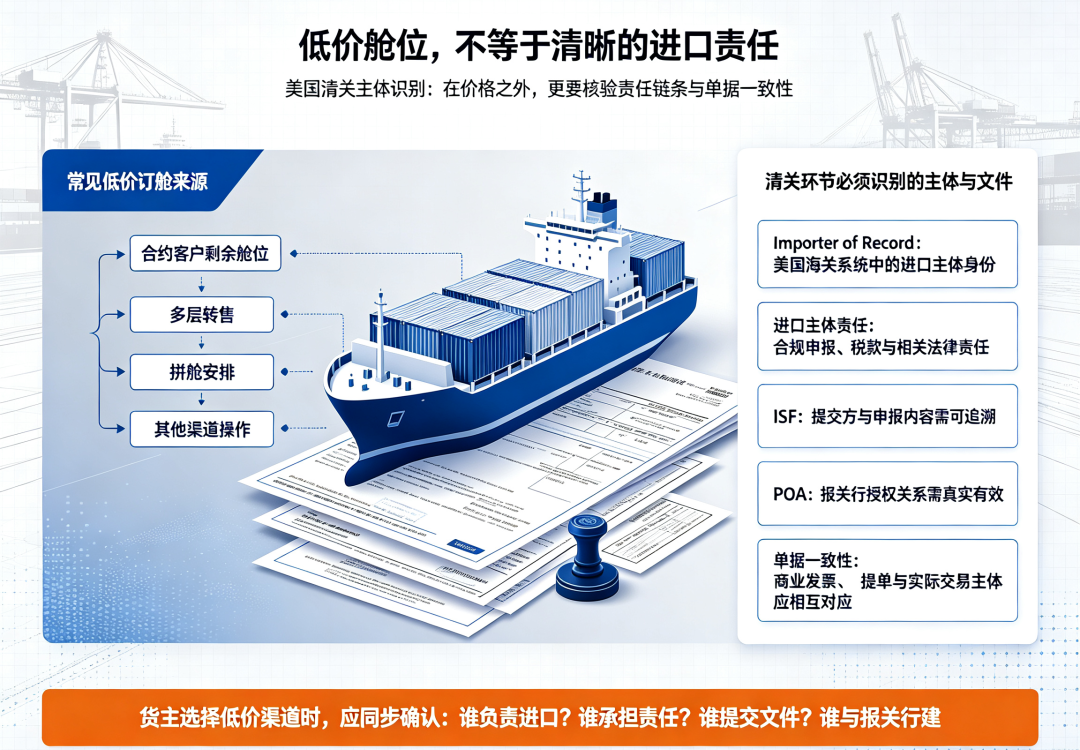
This is also one of the reasons why discussions about BCO cargo, low-cost cargo and IOR risks have increased in the market recently.
There has always been a relatively common operation in the industry: cargo owners cannot get the ideal price, so they book space through low-price channels in the market.
Some low-price cabins come from the remaining cabins of shipping company contract customers, and some involve different levels of resale, space sharing or channel arrangements.
For the cargo owner, on the surface, it is just "whoever offers the lowest price, I will order from him."
But when it comes to U.S. customs clearance, the questions that really need to be answered are:
Who is the Importer of Record?
Who bears the main import responsibility for this shipment in the U.S. customs system?
Who submitted the ISF?
Who signs the POA with the customs broker?
Can this information be matched with commercial invoices, bills of lading and actual transaction entities?
If the cargo owner only sees a very low shipping price but does not understand the import entities and customs clearance links behind it, the real risk may not be on the ship, but will be exposed after the goods arrive in the United States.
01
2O and 2P are also becoming more frequent
Appear in industry discussions
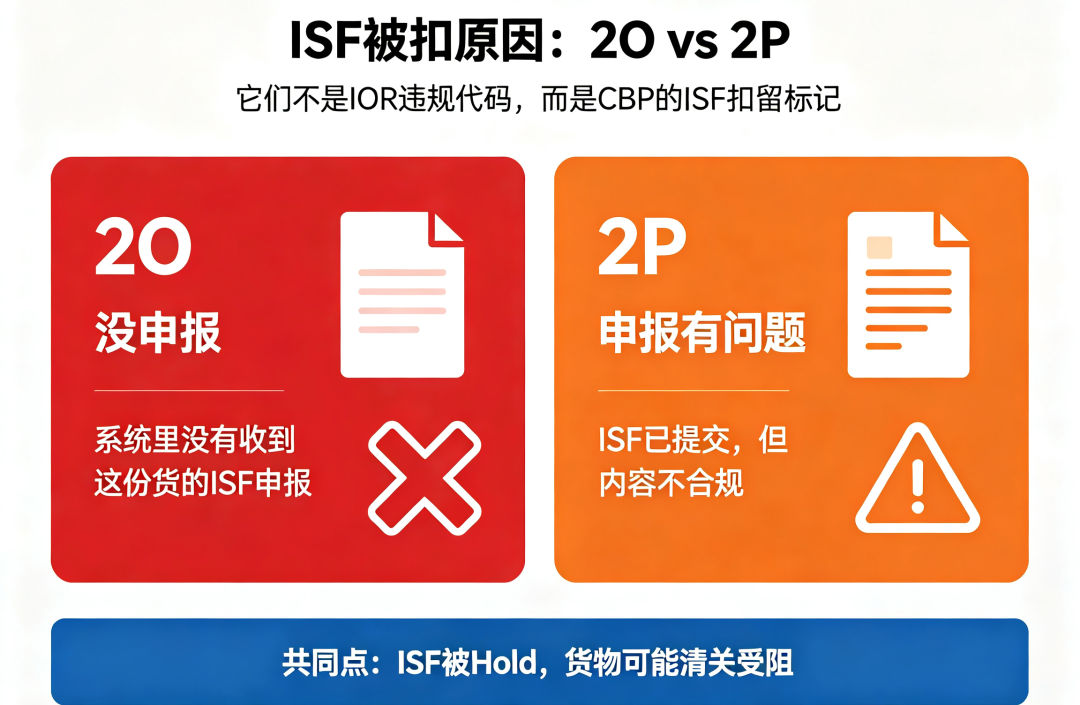
Recently, some logistics channels have also mentioned that there are more 2O and 2P disposal codes in US ports.
It should be noted here that 2O and 2P are not "IOR violation codes".
According to CBP’s ACE Appendix D:
2O stands for ISF Hold—no ISF on file, that is, there is no corresponding ISF declaration in the system;
2P stands for ISF Hold—ISF Compliance Issue, that is, ISF has compliance issues.
Therefore, it is not accurate to directly interpret all the recent 2O and 2P incidents as "IOR being investigated".
But for goods waiting for customs clearance at U.S. ports, there is a data correlation between the ISF, bill of lading, import entity and IOR information.Once there are inconsistencies, the goods may enter further processing.
At present, some industry media and logistics service providers have begun to link the recent port detention phenomenon with the strengthened verification of IOR.
For example, on September 21, 2026, FreightWaves reported that CBP had begun invalidating IOR numbers with inaccurate or incomplete information.Reports pointed out that this may cause relevant companies to be unable to complete U.S. import declarations and cause goods to be stranded at ports or other entry points.
However, FreightWaves also pointed out that CBP has not publicly disclosed how many IOR numbers have been invalidated since the new measures were implemented on September 18.
03
This time, BCO direct customers cannot
Just look at “whether it’s your own product”
Previously, many cargo owners had a relatively simple understanding of BCO direct customers:
The shipping company's contract is its own, the shipping space is its own, and booking is relatively straightforward, so the risk should be lower than through ordinary freight forwarding channels.
But from the perspective of U.S. import compliance, the booking entity and the Importer of Record are not the same thing.
Whether a shipment is a BCO does not automatically prove that there are no problems with its IOR, ISF or customs declaration information.
Similarly, just because the cargo owner's own goods have no obvious violations does not mean that the entire customs clearance link used is free of risks.
There are many opinions on the market about "sharing IOR leading to other goods being jointly and severally detained", but there is no clear provision in CBP public documents that "all goods under the same IOR are automatically jointly and severally detained".
Therefore, a more accurate statement is:
If an IOR is invalidated by CBP, the IOR can no longer be used for import declarations; for goods that are already in transit, waiting for customs clearance, or that subsequently need to use the IOR for import declarations, actual customs clearance and supply chain impacts may indeed occur.
As for whether a specific shipment will be detained, whether it will be returned, and whether it needs to be re-declared, it depends on the specific case and CBP's subsequent processing, and cannot be generalized.
Changes in U.S. Customs
Not just the line of September 18th
This IOR inspection is actually part of the United States’ efforts to strengthen import supervision this year.
On June 3, 2026, the President of the United States signed Executive Order No. 14411, proposing to strengthen IOR identification and continuous review, and required the establishment of a more stringent IOR "good standing" mechanism, while strengthening the review of importers, customs brokers, freight forwarders and other participants.
The order also calls for increased enforcement of underdeclarations, misclassifications, illegal transshipments and other customs violations.
The Form 5106 announcement issued by CBP on August 19 can be regarded as a node where this round of policies has further reached the specific operational level.
So the real change in the U.S. border now is not just whether the inspections are strict or not.
Instead, U.S. Customs is increasingly emphasizing:
Who owns the goods, who is responsible for importing, who submits the information, and whether the information belongs to the subject himself.
In the past, some models that relied on channel resources, low-price shipping spaces or third-party entities to solve US customs clearance issues need to be re-examined next.
03
For freight forwarders and cargo owners
What should you check most now?
For companies that have goods arriving from the United States in the near future, it is recommended to recheck at least a few key links:
First, confirm who the real IOR is.
Don’t just know that “the freight forwarder is responsible for customs clearance”, but know who is the legal entity that ultimately bears import responsibility in the US customs system.
Second, check the Form 5106 information.
Focus on checking whether the company name, actual business address, phone number, email address, EIN and other information are true and complete, and confirm that this information indeed belongs to the IOR.
Third, confirm the POA relationship.
CBP clearly requires that when the customs broker submits relevant information on behalf of the IOR, it should have a valid POA signed directly by the IOR.
Fourth, don’t just focus on the sea freight difference.
A container is a few hundred dollars cheaper, which seems like a good deal; but if there is a problem with the customs clearance entity and the container stays at the port for a few more days, the subsequent storage, detention, order changes, returns and warehousing costs will soon eat up the freight saved earlier.
At present, market rumors that "thousands of containers have been detained" still need to wait for more official information to be confirmed.
However, the enhanced IOR verification that started on September 18 is already a confirmed policy change.
For Chinese freight forwarders and cargo owners, what really needs to be re-examined next may not be "can we still find cheaper US shipping space?" but:
Who are the booking, IOR, ISF and customs clearance entities behind this price?
Being re-identified
On August 19, 2026 local time, CBP issued a notice in the Federal Register clearly stating that it would strengthen verification of the information submitted by new and old IORs in Form 5106.
If CBP determines that the information in Form 5106 is inaccurate or incomplete, it can directly invalidate the corresponding IOR number.
A invalidated IOR number will not be used for related purposes including declaration of imported goods.
This enhanced enforcement measure will be implemented from September 18, 2026.
What CBP is concerned about this time is not just whether an IOR number exists, but whether the subject information behind the number is true and complete.
The announcement specifically mentioned that the company name, physical address, email, phone number, EIN or SSN and other information in Form 5106 must be accurate and should directly belong to the corresponding IOR.
If Form 5106 is submitted by a customs broker, the customs broker must also hold a valid POA signed directly by the IOR.
In other words, some import entities have long continued to use old information and third-party addresses or contact information. Now they are facing significantly increased verification pressure.
02 What really makes the US coil nervous is the main relationship behind the "low-price cabin"
This is also one of the reasons why discussions about BCO cargo, low-cost cargo and IOR risks have increased in the market recently.
There has always been a relatively common operation in the industry: cargo owners cannot get the ideal price, so they book space through low-price channels in the market.
Some low-price cabins come from the remaining cabins of shipping company contract customers, and some involve different levels of resale, space sharing or channel arrangements.
For the cargo owner, on the surface, it is just "whoever offers the lowest price, I will order from him."
But when it comes to U.S. customs clearance, the questions that really need to be answered are:
Who is the Importer of Record?
Who bears the main import responsibility for this shipment in the U.S. customs system?
Who submitted the ISF?
Who signs the POA with the customs broker?
Can this information be matched with commercial invoices, bills of lading and actual transaction entities?
If the cargo owner only sees a very low shipping price but does not understand the import entities and customs clearance links behind it, the real risk may not be on the ship, but will be exposed after the goods arrive in the United States.
01
2O and 2P are also becoming more frequent
Appear in industry discussions
Recently, some logistics channels have also mentioned that there are more 2O and 2P disposal codes in US ports.
It should be noted here that 2O and 2P are not "IOR violation codes".
According to CBP’s ACE Appendix D:
2O stands for ISF Hold—no ISF on file, that is, there is no corresponding ISF declaration in the system;
2P stands for ISF Hold—ISF Compliance Issue, that is, ISF has compliance issues.
Therefore, it is not accurate to directly interpret all the recent 2O and 2P incidents as "IOR being investigated".
But for goods waiting for customs clearance at U.S. ports, there is a data correlation between the ISF, bill of lading, import entity and IOR information.Once there are inconsistencies, the goods may enter further processing.
At present, some industry media and logistics service providers have begun to link the recent port detention phenomenon with the strengthened verification of IOR.
For example, on September 21, 2026, FreightWaves reported that CBP had begun invalidating IOR numbers with inaccurate or incomplete information.Reports pointed out that this may cause relevant companies to be unable to complete U.S. import declarations and cause goods to be stranded at ports or other entry points.
However, FreightWaves also pointed out that CBP has not publicly disclosed how many IOR numbers have been invalidated since the new measures were implemented on September 18.
03
This time, BCO direct customers cannot
Just look at “whether it’s your own product”
Previously, many cargo owners had a relatively simple understanding of BCO direct customers:
The shipping company's contract is its own, the shipping space is its own, and booking is relatively straightforward, so the risk should be lower than through ordinary freight forwarding channels.
But from the perspective of U.S. import compliance, the booking entity and the Importer of Record are not the same thing.
Whether a shipment is a BCO does not automatically prove that there are no problems with its IOR, ISF or customs declaration information.
Similarly, just because the cargo owner's own goods have no obvious violations does not mean that the entire customs clearance link used is free of risks.
There are many opinions on the market about "sharing IOR leading to other goods being jointly and severally detained", but there is no clear provision in CBP public documents that "all goods under the same IOR are automatically jointly and severally detained".
Therefore, a more accurate statement is:
If an IOR is invalidated by CBP, the IOR can no longer be used for import declarations; for goods that are already in transit, waiting for customs clearance, or that subsequently need to use the IOR for import declarations, actual customs clearance and supply chain impacts may indeed occur.
As for whether a specific shipment will be detained, whether it will be returned, and whether it needs to be re-declared, it depends on the specific case and CBP's subsequent processing, and cannot be generalized.
Changes in U.S. Customs
Not just the line of September 18th
This IOR inspection is actually part of the United States’ efforts to strengthen import supervision this year.
On June 3, 2026, the President of the United States signed Executive Order No. 14411, proposing to strengthen IOR identification and continuous review, and required the establishment of a more stringent IOR "good standing" mechanism, while strengthening the review of importers, customs brokers, freight forwarders and other participants.
The order also calls for increased enforcement of underdeclarations, misclassifications, illegal transshipments and other customs violations.
The Form 5106 announcement issued by CBP on August 19 can be regarded as a node where this round of policies has further reached the specific operational level.
So the real change in the U.S. border now is not just whether the inspections are strict or not.
Instead, U.S. Customs is increasingly emphasizing:
Who owns the goods, who is responsible for importing, who submits the information, and whether the information belongs to the subject himself.
In the past, some models that relied on channel resources, low-price shipping spaces or third-party entities to solve US customs clearance issues need to be re-examined next.
03
For freight forwarders and cargo owners
What should you check most now?
For companies that have goods arriving from the United States in the near future, it is recommended to recheck at least a few key links:
First, confirm who the real IOR is.
Don’t just know that “the freight forwarder is responsible for customs clearance”, but know who is the legal entity that ultimately bears import responsibility in the US customs system.
Second, check the Form 5106 information.
Focus on checking whether the company name, actual business address, phone number, email address, EIN and other information are true and complete, and confirm that this information indeed belongs to the IOR.
Third, confirm the POA relationship.
CBP clearly requires that when the customs broker submits relevant information on behalf of the IOR, it should have a valid POA signed directly by the IOR.
Fourth, don’t just focus on the sea freight difference.
A container is a few hundred dollars cheaper, which seems like a good deal; but if there is a problem with the customs clearance entity and the container stays at the port for a few more days, the subsequent storage, detention, order changes, returns and warehousing costs will soon eat up the freight saved earlier.
At present, market rumors that "thousands of containers have been detained" still need to wait for more official information to be confirmed.
However, the enhanced IOR verification that started on September 18 is already a confirmed policy change.
For Chinese freight forwarders and cargo owners, what really needs to be re-examined next may not be "can we still find cheaper US shipping space?" but:
Who are the booking, IOR, ISF and customs clearance entities behind this price?