

A surge of more than 10 times!CMA CGM’s South Africa line surcharges soar, putting pressure on China
- Author:Maintenance network
- Source:Maintenance network
- Release Date:2026-10-20
Entering late October, CMA CGM once again adjusted the peak season surcharges on some routes.This adjustment involves reefer container transportation from China to Durban, South Africa, the east coast of South America to Europe and surrounding markets, and Morocco to West Africa.Among them, the fee changes on the route from China to Durban are particularly worthy of attention by freight forwarders: the peak season surcharge for export goods from South China has risen to US$1,050/TEU, and that for North and Central China has risen to US$1,150/TEU.At the same time, a new round of surcharges from the east coast of South America to Europe, the Mediterranean and other regions will be implemented from November 15, and new charges will also be added for reefer containers from Morocco to West Africa.
China to Durban: South China US$1,050/TEU North China, Central China US$1,150/TEU
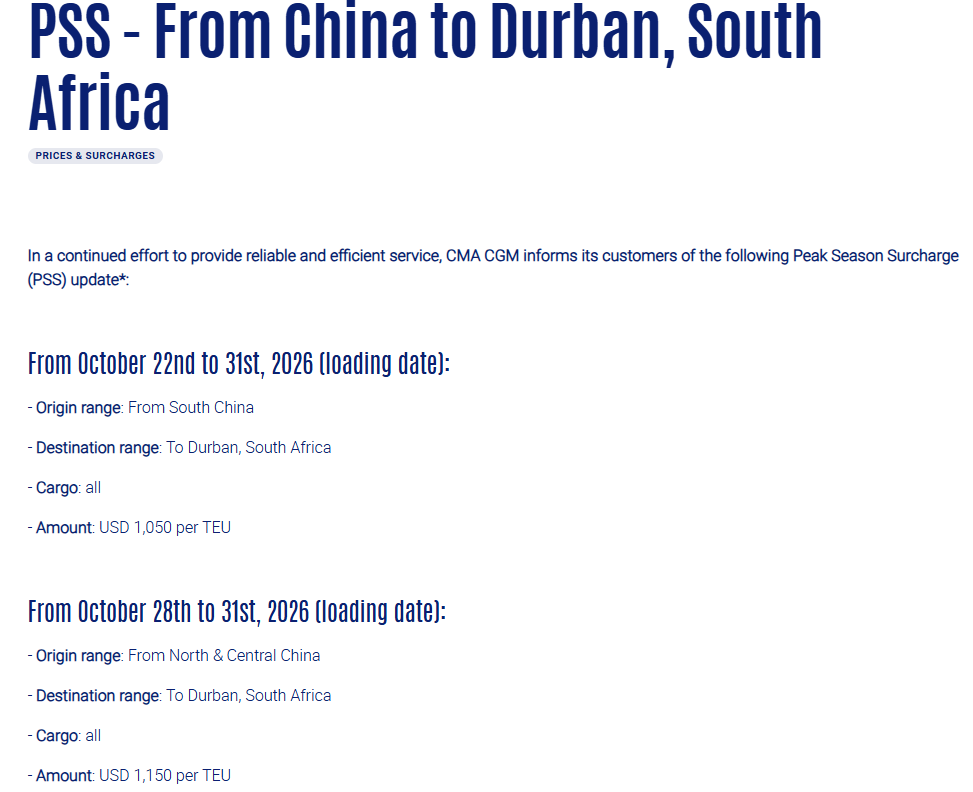
According to the official announcement issued by CMA CGM on October 16, 2026, starting from the corresponding loading date, the following peak season surcharges will be imposed on cargo bound for Durban Port in South Africa: South China to Durban: loading from October 22 to 31, 2026, with a charge of US$1,050/TEU.North China, Central China to Durban: loading from October 28 to 31, 2026, the charge is US$1,150/TEU.Both charges apply to all cargo types.The date listed in the announcement is the loading date, not the ship sailing date.It is worth noting that compared with the initial standard of US$100/TEU announced on September 10, the latest charge has reached 10.5 to 11.5 times the original price.CMA CGM also stated that the PSS involved in China's export goods will be declared to the Shanghai Shipping Exchange as required, or included in the sea freight.Fuel-related surcharges, terminal operating fees at the departure and destination ports, safety and security-related fees, and other applicable fees may still be incurred separately.
This round of adjustments did not happen suddenly. Durban route charges have been raised continuously. If you only look at the latest announcement on October 16, you may think that this charge increase is sudden.But when we put CMA CGM’s previous notices together, the changes become clearer.On September 17, 2026, CMA CGM announced that starting from loading on September 25, the PSS from China, Northeast Asia and Southeast Asia to Durban will be adjusted to US$350/TEU.On September 30, CMA CGM announced another charge update from the Far East to Durban. Starting from October 8, the PSS will be adjusted to US$550/TEU.On October 16, CMA CGM further announced new zoning charges for goods exported from China: South China US$1,050/TEU, North China and Central China US$1,150/TEU.However, the direction of fee adjustment is already clear: the surcharge level on the Durban route has increased significantly in a short period of time.From US$100/TEU to the latest announced US$1,050/TEU and US$1,150/TEU, the change in numbers is enough to remind freight forwarders to recheck their quotations and booking conditions.
PSS will be updated simultaneously from the east coast of South America to Europe and other regions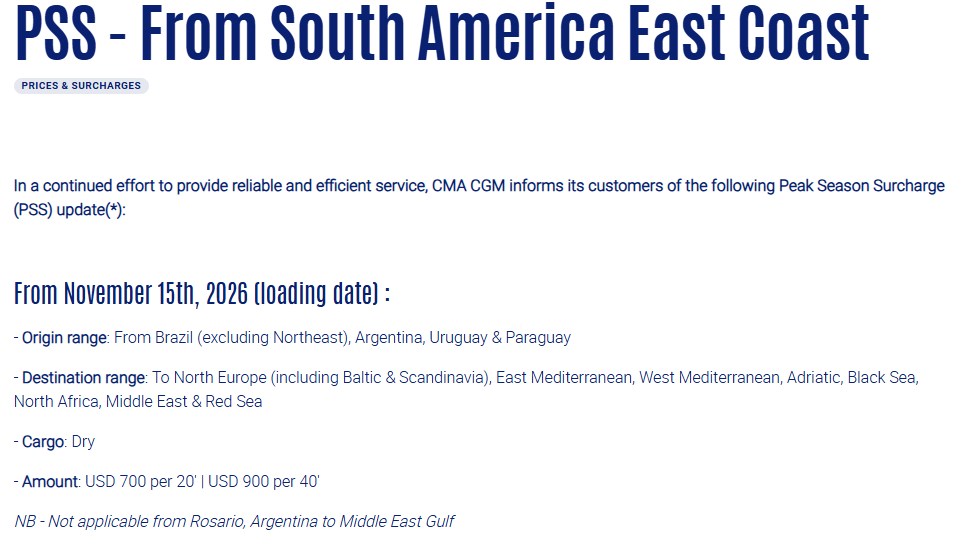
In addition to the fee adjustment from China to Durban, CMA CGM is also updating the peak season surcharges from the east coast of South America to Europe and surrounding markets.According to the announcement issued by CMA CGM on October 16, 2026, starting from November 15, dry containers at the following places of departure will be subject to the new PSS: Place of departure: Brazil (excluding northeastern Brazil), Argentina, Uruguay, and Paraguay.Destinations: Northern Europe (including the Baltic Sea region and Scandinavia), Eastern Mediterranean, Western Mediterranean, Adriatic Sea, Black Sea, North Africa, Middle East and Red Sea.20-foot container: USD 700/container.40-foot container: USD 900/container.Among them, this surcharge does not apply to transportation from Rosario, Argentina to the Middle East Gulf region.There is another point to note in this announcement: the new charges only apply to dry containers and cannot be directly applied to reefers or other special container types.At the same time, the destination covers multiple areas, and the freight forwarder should confirm whether it is applicable based on the specific port when checking the price, rather than just judging by the broad categories of "European route" or "Middle East route".Looking back at the previous arrangements, CMA CGM announced the PSS from the east coast of South America to Europe and other regions on October 1, which will be implemented from November 1 at a price of US$500 per container. The scope of application includes dry containers and refrigerated containers.The new announcement on October 16 adjusted the effective date to November 15, and listed the charging standards of US$700 and US$900 respectively for 20-foot containers and 40-foot containers for the new scope of application.The applicable dates, cargo types, destination ranges and charging standards of these two announcements are not entirely consistent.When making actual bookings, the latest announcement applicable to the corresponding route and loading date should be used to avoid mixing charges from different versions together.
China to Durban: South China US$1,050/TEU North China, Central China US$1,150/TEU
According to the official announcement issued by CMA CGM on October 16, 2026, starting from the corresponding loading date, the following peak season surcharges will be imposed on cargo bound for Durban Port in South Africa: South China to Durban: loading from October 22 to 31, 2026, with a charge of US$1,050/TEU.North China, Central China to Durban: loading from October 28 to 31, 2026, the charge is US$1,150/TEU.Both charges apply to all cargo types.The date listed in the announcement is the loading date, not the ship sailing date.It is worth noting that compared with the initial standard of US$100/TEU announced on September 10, the latest charge has reached 10.5 to 11.5 times the original price.CMA CGM also stated that the PSS involved in China's export goods will be declared to the Shanghai Shipping Exchange as required, or included in the sea freight.Fuel-related surcharges, terminal operating fees at the departure and destination ports, safety and security-related fees, and other applicable fees may still be incurred separately.
This round of adjustments did not happen suddenly. Durban route charges have been raised continuously. If you only look at the latest announcement on October 16, you may think that this charge increase is sudden.But when we put CMA CGM’s previous notices together, the changes become clearer.On September 17, 2026, CMA CGM announced that starting from loading on September 25, the PSS from China, Northeast Asia and Southeast Asia to Durban will be adjusted to US$350/TEU.On September 30, CMA CGM announced another charge update from the Far East to Durban. Starting from October 8, the PSS will be adjusted to US$550/TEU.On October 16, CMA CGM further announced new zoning charges for goods exported from China: South China US$1,050/TEU, North China and Central China US$1,150/TEU.However, the direction of fee adjustment is already clear: the surcharge level on the Durban route has increased significantly in a short period of time.From US$100/TEU to the latest announced US$1,050/TEU and US$1,150/TEU, the change in numbers is enough to remind freight forwarders to recheck their quotations and booking conditions.
PSS will be updated simultaneously from the east coast of South America to Europe and other regions
In addition to the fee adjustment from China to Durban, CMA CGM is also updating the peak season surcharges from the east coast of South America to Europe and surrounding markets.According to the announcement issued by CMA CGM on October 16, 2026, starting from November 15, dry containers at the following places of departure will be subject to the new PSS: Place of departure: Brazil (excluding northeastern Brazil), Argentina, Uruguay, and Paraguay.Destinations: Northern Europe (including the Baltic Sea region and Scandinavia), Eastern Mediterranean, Western Mediterranean, Adriatic Sea, Black Sea, North Africa, Middle East and Red Sea.20-foot container: USD 700/container.40-foot container: USD 900/container.Among them, this surcharge does not apply to transportation from Rosario, Argentina to the Middle East Gulf region.There is another point to note in this announcement: the new charges only apply to dry containers and cannot be directly applied to reefers or other special container types.At the same time, the destination covers multiple areas, and the freight forwarder should confirm whether it is applicable based on the specific port when checking the price, rather than just judging by the broad categories of "European route" or "Middle East route".Looking back at the previous arrangements, CMA CGM announced the PSS from the east coast of South America to Europe and other regions on October 1, which will be implemented from November 1 at a price of US$500 per container. The scope of application includes dry containers and refrigerated containers.The new announcement on October 16 adjusted the effective date to November 15, and listed the charging standards of US$700 and US$900 respectively for 20-foot containers and 40-foot containers for the new scope of application.The applicable dates, cargo types, destination ranges and charging standards of these two announcements are not entirely consistent.When making actual bookings, the latest announcement applicable to the corresponding route and loading date should be used to avoid mixing charges from different versions together.
New surcharge of 250 euros/TEU for reefer containers from Morocco to West Africa
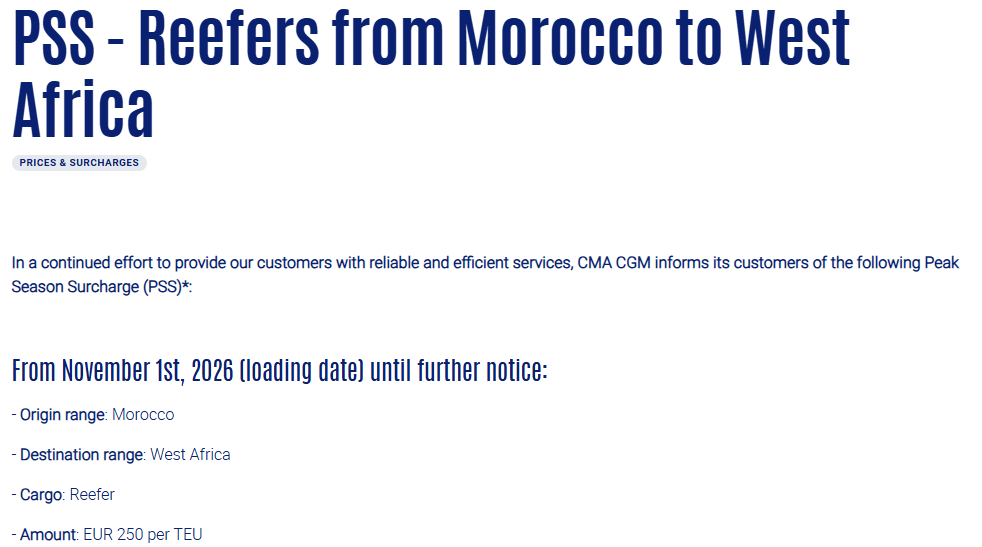
There are also new charging arrangements for reefer container transport.CMA CGM announced on October 16, 2026 that starting from November 1, reefer containers from Morocco to West Africa will be subject to a peak season surcharge of 250 euros/TEU, and the implementation period will be until further notice.For freight forwarders dealing in fresh produce, food and other temperature-controlled goods, the reefer itself involves temperature control requirements, equipment arrangements and transportation connections.After adding a surcharge, in addition to checking the freight, the applicable surcharge should also be included in the entire transportation cost. In particular, confirm whether the quotation already includes this charge.CMA CGM also reminds that in addition to the basic sea freight, fuel-related surcharges, THC at the port of departure and port of destination, safety and security-related fees, and other applicable fees may still be incurred.
Not only PSS, FAK freight rates from Asia to the Mediterranean and North Africa will also be adjusted in November.
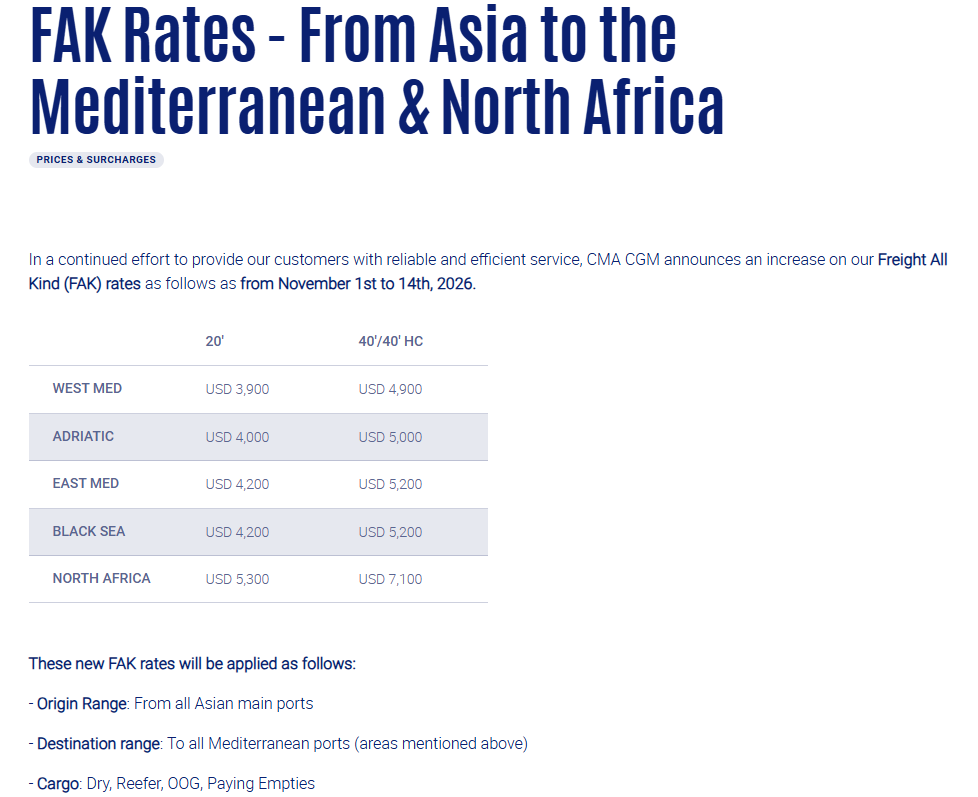
If the business is focused on China's exports to Europe and surrounding markets, another recent announcement is worth checking out as well.On October 16, 2026, CMA CGM announced the FAK adjustment from Asia to the Mediterranean and North Africa, which is applicable from November 1 to 14.The freight rates listed in the announcement are as follows: Western Mediterranean: US$3,900 for a 20-foot container, US$4,900 for a 40-foot container and a 40-foot high container.Adriatic Sea: 20-foot container is US$4,000, 40-foot container and 40-foot high container are US$5,000.Eastern Mediterranean: USD 4,200 for a 20-foot container, USD 5,200 for a 40-foot container and a 40-foot high container.Black Sea: 20-foot container is US$4,200, 40-foot container and 40-foot high container are US$5,200.North Africa: 20-foot container is US$5,300, 40-foot container and 40-foot high container are US$7,100.The above FAK applies to transportation from major ports in Asia to the Mediterranean areas listed in the announcement, covering dry containers, reefer containers, over-limit cargo and paid empty containers, etc.The announcement explains that the rates listed include basic sea freight, fuel-related surcharges, EU emissions trading system-related fees and low-sulfur fuel surcharges, but THC, safety and security-related fees and other applicable fees at the departure and destination ports may still be charged separately.For freight forwarders, the FAK freight rate in the first half of November and the PSS on the east coast of South America from November 15 respectively correspond to different origins, destinations and effective times.When making quotations, the most common problem is not missing a number, but mixing announcements with different dates, different routes or different charging standards.
Industry observation
These announcements involve different routes, so it cannot be judged that all ocean routes are increasing prices simultaneously.But for Chinese freight forwarders, one thing is very practical: the booking quotation cannot just focus on the basic sea freight.For Durban routes, you need to check the departure area and loading date, for European and surrounding routes, you need to confirm the FAK validity period, and for South American export business, you need to pay attention to the new charging standards starting from November 15.For orders that have already quoted prices to customers but have not yet completed loading, it is especially necessary to re-confirm the validity period of the quotation, whether surcharges are included, and who will bear the new charges.During the peak season, a shipping fee difference of several hundred dollars may affect the profit of a shipment.The announcement seems to be just a few lines of numbers, but when it comes to business, the difference may be the cost of an entire shipment.
There are also new charging arrangements for reefer container transport.CMA CGM announced on October 16, 2026 that starting from November 1, reefer containers from Morocco to West Africa will be subject to a peak season surcharge of 250 euros/TEU, and the implementation period will be until further notice.For freight forwarders dealing in fresh produce, food and other temperature-controlled goods, the reefer itself involves temperature control requirements, equipment arrangements and transportation connections.After adding a surcharge, in addition to checking the freight, the applicable surcharge should also be included in the entire transportation cost. In particular, confirm whether the quotation already includes this charge.CMA CGM also reminds that in addition to the basic sea freight, fuel-related surcharges, THC at the port of departure and port of destination, safety and security-related fees, and other applicable fees may still be incurred.
Not only PSS, FAK freight rates from Asia to the Mediterranean and North Africa will also be adjusted in November.
If the business is focused on China's exports to Europe and surrounding markets, another recent announcement is worth checking out as well.On October 16, 2026, CMA CGM announced the FAK adjustment from Asia to the Mediterranean and North Africa, which is applicable from November 1 to 14.The freight rates listed in the announcement are as follows: Western Mediterranean: US$3,900 for a 20-foot container, US$4,900 for a 40-foot container and a 40-foot high container.Adriatic Sea: 20-foot container is US$4,000, 40-foot container and 40-foot high container are US$5,000.Eastern Mediterranean: USD 4,200 for a 20-foot container, USD 5,200 for a 40-foot container and a 40-foot high container.Black Sea: 20-foot container is US$4,200, 40-foot container and 40-foot high container are US$5,200.North Africa: 20-foot container is US$5,300, 40-foot container and 40-foot high container are US$7,100.The above FAK applies to transportation from major ports in Asia to the Mediterranean areas listed in the announcement, covering dry containers, reefer containers, over-limit cargo and paid empty containers, etc.The announcement explains that the rates listed include basic sea freight, fuel-related surcharges, EU emissions trading system-related fees and low-sulfur fuel surcharges, but THC, safety and security-related fees and other applicable fees at the departure and destination ports may still be charged separately.For freight forwarders, the FAK freight rate in the first half of November and the PSS on the east coast of South America from November 15 respectively correspond to different origins, destinations and effective times.When making quotations, the most common problem is not missing a number, but mixing announcements with different dates, different routes or different charging standards.
Industry observation
These announcements involve different routes, so it cannot be judged that all ocean routes are increasing prices simultaneously.But for Chinese freight forwarders, one thing is very practical: the booking quotation cannot just focus on the basic sea freight.For Durban routes, you need to check the departure area and loading date, for European and surrounding routes, you need to confirm the FAK validity period, and for South American export business, you need to pay attention to the new charging standards starting from November 15.For orders that have already quoted prices to customers but have not yet completed loading, it is especially necessary to re-confirm the validity period of the quotation, whether surcharges are included, and who will bear the new charges.During the peak season, a shipping fee difference of several hundred dollars may affect the profit of a shipment.The announcement seems to be just a few lines of numbers, but when it comes to business, the difference may be the cost of an entire shipment.